1. History
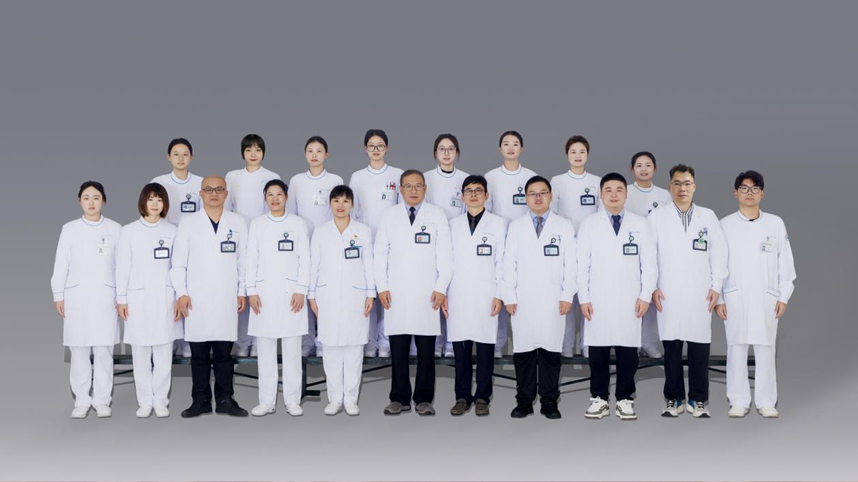
The departmentbegan preparations in June 2018 and was formally established as theCardiothoracic Surgery Service (Fifth Surgical Ward) in April 2020.
2. Honors &Accreditations
Standing CouncilMember, Cardiothoracic Surgery Branch, Guangdong Association of IntegratedTraditional Chinese and Western Medicine
StandingCommittee Member, Thoracic Surgery Branch and Cardiac Surgery Branch, ShenzhenMedical Association
StandingCommittee Member, Thoracic Surgery Branch and Cardiac Surgery Branch, ShenzhenMedical Doctor Association
Quality ControlCenter Unit, Thoracic Surgery, Shenzhen Medical Association
HospitalExcellent Satisfaction Award (2024)
3. Leadership
Professor ChengYing, Chief Physician, Academic Leader, and Master's Supervisor, has directedthe department from its inception through its establishment and continuedgrowth.
4. ClinicalFocus
We are committedto the diagnosis and surgical treatment of cardiothoracic diseases, with activeresearch programs investigating the application of traditional Chinese medicine(TCM) and TCM-appropriate techniques in cardiothoracic surgical care—spanning basic mechanistic studies to clinical trials.
5. Operations& Clinical Services
Campuses
Futian Campus:outpatient clinics and inpatient wards
GuangmingCampus: outpatient clinics and inpatient wards
SpecialtyClinics
Pulmonary nodule& lung cancer
Esophagealcancer
Mediastinaltumors
Chest walltumors and deformities
Postoperativerehabilitation after lung cancer surgery
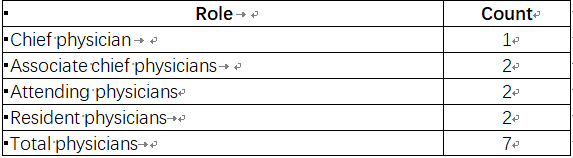
Team Composition
6. SurgicalCapabilities
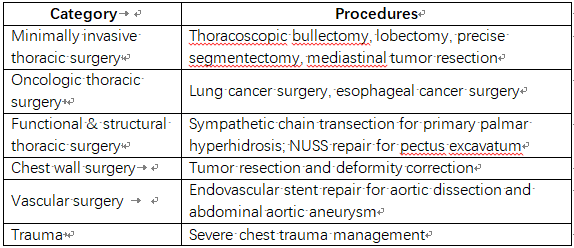
We routinelyperform the full spectrum of tertiary-level cardiothoracic procedures:
ThoracoscopyUtilization
Minimallyinvasive thoracoscopic approaches are employed in >98% of eligible cases,including:
l Pulmonarynodules
l Lungcancer
l Hemopneumothorax
l Mediastinaltumors
l Esophagealtumors
l Primarypalmar hyperhidrosis
l Pectusexcavatum
StandardSingle-Port Thoracoscopic Procedures
l Bullectomy
l Lobectomy
l Precisionsegmentectomy
l Mediastinaltumor resection
l Thoracicsympathetic chain transection
l NUSS procedure
ClinicalAdvantages: Minimal trauma, rapid recovery, cosmetically favorable incisions.
7. IntegratedTCM–Western Care
Philosophy
We integrate thestrengths of TCM with modern surgical practice, pursuing a full-cyclemanagement model with TCM characteristics for thoracic and cardiovasculardiseases.
Perioperative TCM Rehabilitation
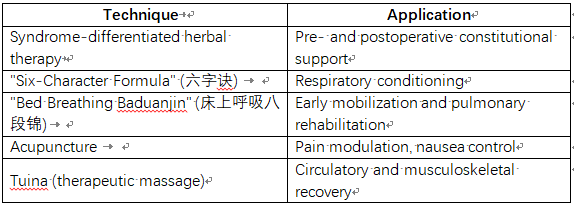
These modalitiesaccelerate postoperative recovery and reduce complications.
8. Center ofExcellence: Pulmonary Nodule Management
Our dominantdisease focus is the integrated management of pulmonary nodules. We havedeveloped a characteristic TCM-enriched protocol that combines:
l Syndrome-differentiatedherbal therapy
l PerioperativeTCM-appropriate techniques
l Enhancedrecovery after surgery (ERAS) principles
This optimizedapproach delivers seamless, patient-centered care from diagnosis throughrehabilitation.
Key revisionsfor international readability:
Departmentnaming — Clarified "外五科"as Cardiothoracic Surgery (Fifth Surgical Department), eliminating ambiguity.
Eliminatedredundant "Department Honors" preamble — Converted 5 membershipsinto clean bulleted list; separated the 2024 award as distinct achievement.
Leadershipstatement tightened — "Has made outstanding contributionsto preparation, establishment and development" → "has directed the department from its inception through its establishmentand continued growth."
Operationssection restructured — Separated campuses, specialty clinics, andteam composition into scannable subsections with table for staff roles.
Surgicalcapabilities reorganized — Grouped by surgical categoryrather than disease list; created dedicated table for procedure types.
Thoracoscopymetrics highlighted — ">98% application rate" andsingle-port portfolio extracted as key quality indicators.
TCM integrationelevated — Moved from closing paragraph to dedicatedsection with technique table, explaining "六字诀"and "床上呼吸八段锦" as respiratory rehabilitationmodalities.
Pulmonary nodule as showcase — Created "Center ofExcellence" section emphasizing the department's signature integratedprotocol, replacing repetitive closing statements.