1. History
l 1980: Hospitaldisinfection room established
l 1992: Formallydesignated as Central Sterile Supply Department (CSSD)
l 1993: AwardedCertificate of Qualification for Sterile Supply Room by Provincial HealthDepartment
l 2005:Re-accredited following inspection by municipal nursing expert panel
l Ongoing:Annual passage of Shenzhen Medical Quality Assessment
2. Honors & Standing
As a core clinical support service, the CSSDserves as the hospital's frontline defense for medical quality and patientsafety. Through decades of continuous improvement, we have developed into acenter of excellence distinguished by:
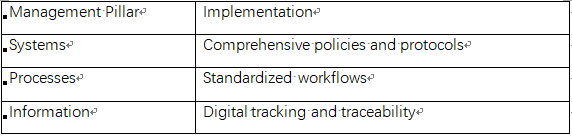
This "trinity" management modelensures advanced technology, standardized practice, and efficient operations.Our full-cycle quality control system—spanning collection → cleaning → packaging → sterilization → distribution—maintains a 100% sterilization pass rate.
3. Leadership
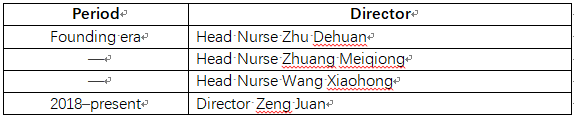
The founding directors established thedepartment's operational foundation. Director Zeng Juan has led the CSSD since2018.
4. Core Functions
The CSSD manages the complete lifecycle ofreusable medical devices and disposable sterile supplies for the entirehospital:
Reusable Instruments
l Collection andtransport
l Cleaning anddisinfection
l Inspection andpackaging
l Sterilization
l Storage anddistribution
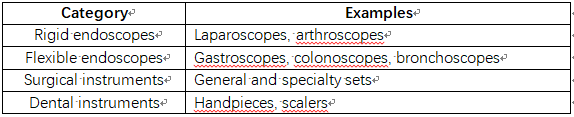
Device Categories
Disposable SterileSupplies
l Centralizedprocurement, storage, and distribution
Additional Responsibilities
l Teaching andtraining for CSSD specialists
l Research insterilization science and quality improvement
5. Operations &Infrastructure
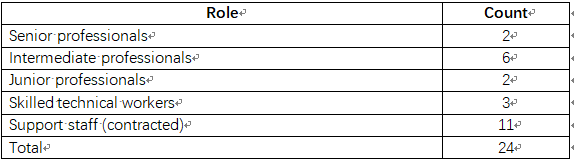
5.1 Team Composition
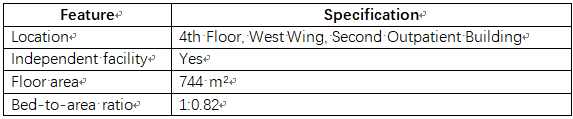
5.2 Facility
5.3 Zoned Workflow
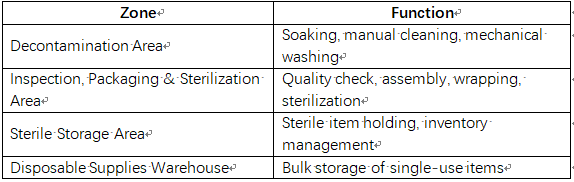
Logistical Advantage: Directcorridor connection to operating rooms on the same floor, enabling rapid,contamination-free supply delivery.
5.4 Equipment
Water Purification

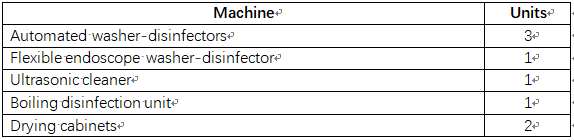
Decontamination Equipment
Sterilization Equipment

6. Quality &Information Systems
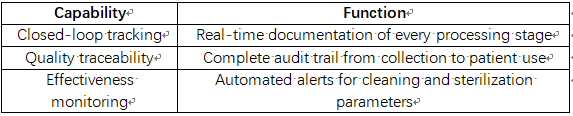
Digital InformationManagement
Key revisions for internationalreadability:
Department naming — "消毒供应中心" standardized as Central Sterile Supply Department (CSSD), theinternationally recognized term, with Chinese abbreviation explained on firstuse.
History timeline created — Fourmilestones (1980, 1992, 1993, 2005) extracted from prose into chronologicaltable with accreditation context.
"Department Honors" completelyrestructured — Removed self-congratulatory preamble ("solid barrier,""professional highland") and converted into objective managementframework table with 100% pass rate as verifiable metric.
Leadership timeline created — Threefounding head nurses and current director presented chronologically; "makingoutstanding contributions" replaced with active "establishedoperational foundation."
Core functions reorganized — Original dense paragraph separated into reusable lifecycle, device categories(with examples), and disposable supplies; teaching/research responsibilitiesadded.
Operations completely restructured — Teamcomposition, facility specifications, zoned workflow, and equipment each givendedicated subsection with tables; bed-to-area ratio and same-floor ORconnection highlighted as quality indicators.
Equipment categorized by function — Decontamination and sterilization equipment separated into distinct tables withunit counts; sterilization technologies annotated with applications (general,heat-sensitive, rapid-turnaround).
Quality systems elevated — Digital information management extracted from closing sentence to dedicatedsection with capability-function table, emphasizing closed-loop tracking andtraceability as patient safety measures.
Active voice throughout — "It has built a full-process quality control system" → "Our full-cycle quality control system maintains";"realizing the whole-process closed-loop recording" → "Real-time documentation of every processing stage."